How thick should a bag be? – A film thickness guide
Wall thickness decides both the load capacity and the price of a bag: too thin and it tears, too thick and it costs more than it should. How to choose the right one.
What does a micron mean?
Film thickness is given in microns (µm): 1 micron = 0.001 mm, so a 40-micron film is 0.04 mm thick. For comparison, a human hair is about 70 and a sheet of office paper about 100 microns. For bags the figure is the wall thickness, the thickness of a single layer – the two walls of the bag together are twice that. Quotes from the UK or the US often use gauge: 100 gauge ≈ 25 microns.
What does the right thickness depend on?
- The weight and nature of the load – heavy, sharp or pointed contents need a thicker or tougher film.
- The material – a thinner HDPE film or LLDPE blend can carry what a thicker LDPE film does. We compared the materials here.
- How it is used – manual lining, automatic filling lines and robotic packing each need a different stiffness.
- Storage and transport – outdoor storage, cold and repeated handling all count.
- Recycled material – film from recycled granules is usually thicker for the same strength; we make it from 20 microns upwards.
Typical thicknesses
The values below are a starting point; we always match the final thickness to the actual application.
| Application | Typical wall thickness |
|---|---|
| Light pouches (e.g. bakery goods, small parts) | HDPE: 8–15 µm, LDPE: 20–40 µm |
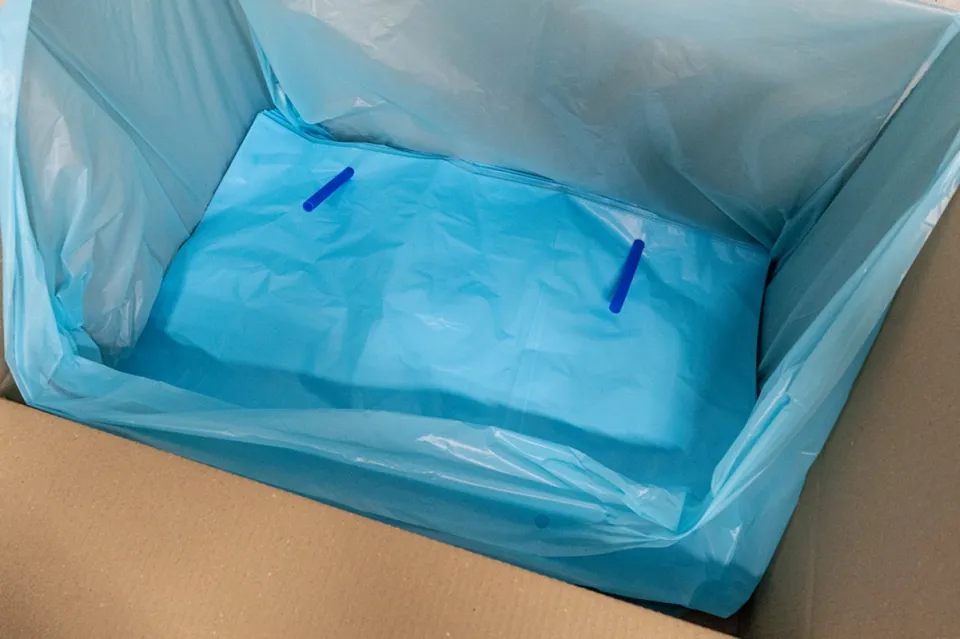
| Crate and box liners | 15–50 µm |
| Household and office garbage bags | 20–40 µm |
| Pallet top sheets and covers | 20–100 µm, depending on pallet weight and storage |
| Industrial garbage bags, container liners | 50–100 µm |
| Heavy or sharp items, heavy-duty cover films | 100–200 µm |
Our plant produces film from 8 to 200 microns – the exact range for each product is on the product pages.
A thinner film can make a stronger bag
Thickness is only one factor. With the right blend – adding LLDPE, for example – or with three-layer coex technology the film can be thinner while keeping its load capacity. That means less raw material, lower weight and lower cost. Our page on film production shows how multi-layer film is made.
Thickness and price: weight is what counts
Film is usually priced by the kilogram, and weight is directly proportional to thickness: a bag of 30 instead of 40 microns needs 25% less raw material. A 600 × 900 mm LDPE bag weighs about 40 g at 40 microns and about 30 g at 30 microns – close to 100 kg difference over 10,000 bags. Try your own sizes in the film calculator; the formula is explained in this article.
If you are unsure
Tell us what you pack, how much and how – or what did not work with your current bag – and we will suggest a material and thickness.